











 GPT-powered ticket routing
 Email & WhatsApp inbox
 Sentiment detection
 1-60 min check intervals.
 Email & Google Chat alerts
 Global Checks
 Auto-trains on any URL
 Built-in lead capture
 One-line JS embed

























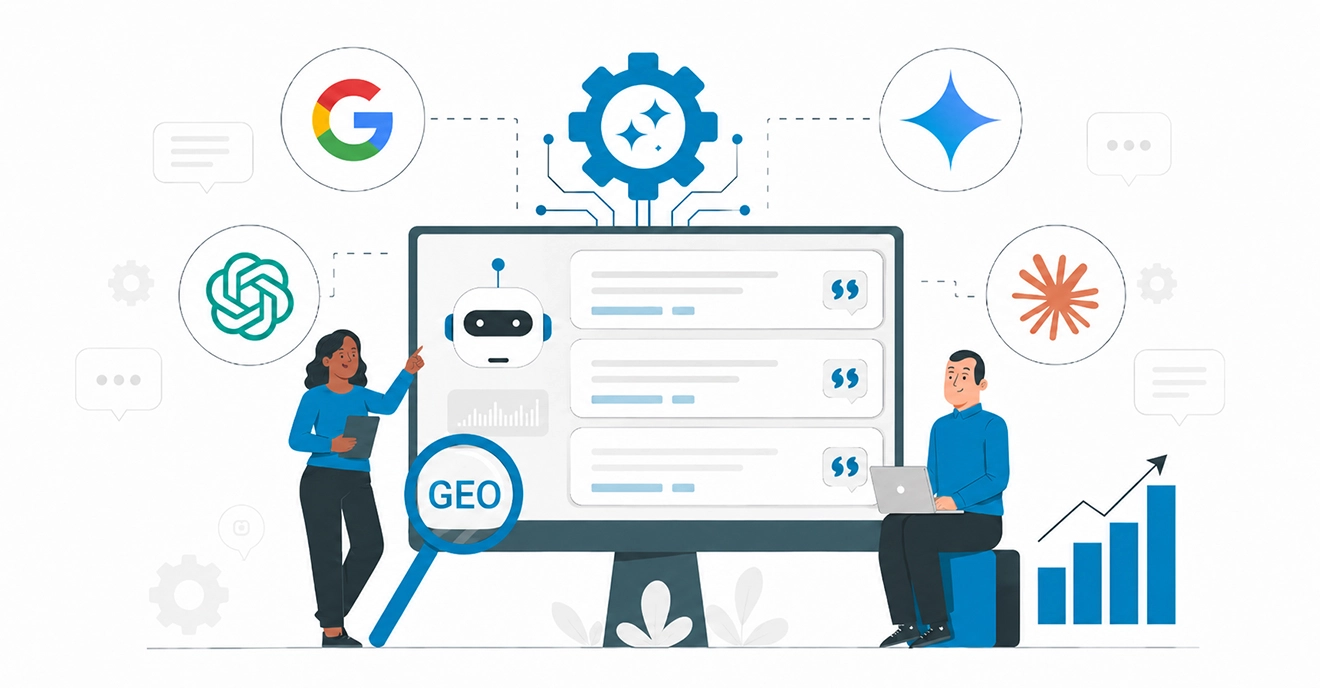
Ask ChatGPT to shortlist a payment gateway, an ERP consultant or an HVAC supplier and it names specific companies. If your business never appears in those answers, you are losing buyers before they ever reach a search results page. Generative engine optimization (GEO) is the discipline of earning those citations.
The shift is measurable. According to Pew Research Center, users click a traditional link on just 8% of Google searches that show an AI summary, compared with 15% when no summary appears (Source: Pew Research Center, 2025¹).
This guide explains how ChatGPT, Gemini and Google’s AI Overviews decide which sources to quote, then gives you a practical plan to become one of them. It is written for business owners and marketing leads, not machine learning engineers.
What Is Generative Engine Optimization?
Generative engine optimization is the practice of structuring your content, data and brand signals so AI systems cite your business as a source in their answers. The targets include ChatGPT, Google’s AI Overviews and AI Mode, Gemini, Perplexity and Claude. Some agencies call the same work LLM SEO or answer engine optimisation; the goal is identical.
The term comes from a 2024 study by researchers at Princeton University and IIT Delhi. They tested nine optimisation methods across 10,000 search queries and found that adding citations, quotations and statistics lifted a site’s visibility in generative engine responses by up to 40% (Source: Aggarwal et al., KDD 2024³).
That study matters because it proved AI answers respond to deliberate, measurable changes. GEO is not a dark art. It rewards what a careful editor rewards: clear claims backed by named sources.
GEO vs SEO: What Actually Changes
SEO earns you a ranking; GEO earns you a quotation. That single difference changes what you optimise for.
- Unit of competition. SEO ranks whole pages. GEO retrieves individual passages, so every section must stand on its own.
- Success metric. SEO measures positions and clicks. GEO measures citation share: how often relevant AI answers name your brand.
- Authority signals. SEO leans on backlinks. GEO also counts unlinked brand mentions, reviews and consistent descriptions of your business across the web.
- Query shape. People ask AI tools long, conversational questions that rarely show up in keyword research tools.
Do not treat the two as rivals. AI Overviews are assembled from Google’s index using its core ranking systems, and ChatGPT’s browsing runs on Bing’s index, so a page that cannot rank cannot be retrieved. HMMBiz treats GEO as an extension of SEO: technical health gets you into the room, and GEO decides whether you get quoted.
How ChatGPT, Gemini and AI Overviews Pick Their Sources
Every generative engine answers in two steps: it retrieves candidate documents, then it generates a response and decides which sources deserve a citation. You can influence both steps, and AI Overviews optimisation depends on getting the first one right.
Retrieval is still search. AI Overviews pull from Google’s index, ChatGPT browses through Bing, Gemini grounds answers in Google Search results and Perplexity runs its own crawler. If AI crawlers such as GPTBot or Google-Extended are blocked in your robots.txt, you have quietly opted out of the answer.
Selection is editorial. Once candidate pages are retrieved, models favour passages that are:
- Self-contained. The claim makes complete sense without reading the rest of the page.
- Attributed. Numbers carry a named source and a year.
- Recent. Visible publish and update dates signal freshness.
- Consistent. The statement agrees with what other trusted sources say on the topic.
- Plainly written. Promotional copy gets skipped; factual statements get quoted.
The cost of ignoring this keeps rising. Ahrefs measured a 58% lower click-through rate for the top-ranking page when an AI Overview appears (Source: Ahrefs, 2025²). Those clicks are not coming back, so the citation itself has become the prize.
Six GEO Tactics That Earn AI Citations
You do not need new channels to win citations. In HMMBiz client work, the fastest gains come from reshaping pages a business already owns.
1. Write answer-first, extractable content
Open every important section with a direct answer of one or two sentences, then add depth beneath it. LLMs quote passages, not pages, and they favour text near the top of a section. A useful test: if a reader saw only your first paragraph, would they still get the answer?
2. Deploy schema and structured data
Schema markup helps machines resolve what a page covers and who published it. Prioritise Article, FAQPage, Organization and Product types, and keep the markup synchronised with the visible text. Structured data will not force a citation, but it removes ambiguity at the retrieval step.
3. Build entity and brand mentions
AI models learn who you are from every mention of your brand, linked or not. Keep your company name, description and category identical across your website, LinkedIn, directories, review platforms and industry listings. In GEO, an unlinked mention on a trusted site carries weight that classic SEO never assigned to it.
4. Run digital PR for third-party validation
LLMs weight consensus, so a claim repeated by independent sources tends to become the answer. Pitch industry publications, contribute expert commentary and publish original data that others want to reference. Community platforms count too: Reddit and Quora threads are cited heavily across AI tools, so answer real questions there under your own name.
5. Add an llms.txt file
llms.txt is a proposed markdown file at your domain root that lists your most important pages with short descriptions for AI crawlers. No major platform has confirmed it as a ranking input, so treat it as cheap insurance rather than a strategy. It takes under an hour to create, which is exactly why it sits at the bottom of this list rather than the top.
6. Structure FAQs the way LLMs retrieve them
Write questions exactly as a customer would type them, then answer in the first sentence. Keep each answer to two to four sentences and mark the block up with FAQPage schema. Anchor every question to a real long-tail query so the page earns People Also Ask visibility while it earns citations.
Read How We Successfully Cited Our Client
HMMBiz worked with a leading HVAC and ventilation solutions provider whose deep product expertise was invisible in search. We delivered a complete digital transformation: a new website, a B2B SEO strategy and structured content optimisation built around the questions engineers and buyers actually ask. The outcome: stronger brand authority and consistent organic lead growth in the manufacturing sector.
Read the Full Case Study: Leading HVAC & Ventilation Solutions Provider
Would ChatGPT recommend your business today?
HMMBiz builds GEO-ready SEO programmes that earn Google rankings and AI citations from the same content.
How to Measure Your AI Visibility
Citation share is the core GEO metric: the percentage of relevant AI answers that mention your brand. Build a fixed set of 15 to 20 prompts your customers would genuinely ask, run them through ChatGPT, Gemini and Perplexity every month, and log whether you are cited, mentioned or absent. HMMBiz runs this as a monthly citation-share report for clients alongside standard rank tracking.
Then wire up your analytics. Create referral segments for chatgpt.com, gemini.google.com, perplexity.ai and copilot.microsoft.com so you can see exactly what AI answers send you. Volumes look small next to organic search, but they are moving: click-through on AI Overviews rose from 1.3% in December 2025 to 2.4% in February 2026 (Source: Search Engine Land, 2026⁴).
Review the prompt log quarterly. If a competitor owns a prompt that matters to you, study which of their pages gets cited and out-structure it.
Your 30-Day GEO Action Checklist
GEO rewards sequencing. Fix retrievability first, extractability second and authority third, because each layer depends on the one before it.
Week 1: Audit
- Run your 15-20 customer prompts through ChatGPT, Gemini and Perplexity; record your baseline citation share
- Check robots.txt and confirm GPTBot, Google-Extended, PerplexityBot and ClaudeBot are not blocked unintentionally
- Shortlist the 10 pages most likely to answer buyer questions
Week 2: Restructure
- Rewrite those 10 pages answer-first, with a direct response in the opening two sentences of each section
- Turn heading topics into real questions and add an FAQ block where the page can support one
Week 3: Markup and align
- Add Article, FAQPage and Organization schema to the restructured pages
- Publish llms.txt and fix inconsistent brand descriptions across directories and profiles
Week 4: Build authority
- Pitch one digital PR story or publish one piece of original data worth referencing
- Set up AI referral segments in analytics and diarise the monthly prompt test
If that reads like a heavier lift than your team can absorb this quarter, fold it into a broader digital marketing programme rather than running GEO as a side project. The businesses winning citations in 2026 are the ones that made it someone’s job.
The next customer who asks an AI about your industry should hear your name.
HMMBiz helps businesses earn Google rankings and AI citations through SEO, content and digital marketing done properly.
 +1 862-246-6249
FAQs
1. What is generative engine optimization (GEO)?
Generative engine optimization is the practice of optimising your content and brand signals so AI tools such as ChatGPT, Gemini and Google’s AI Overviews cite your business in their answers. It focuses on being quoted as a source rather than ranked as a link.
2. How is GEO different from traditional SEO?
GEO targets citations inside AI-generated answers, while SEO targets rankings in a list of links. GEO rewards extractable passages, attributed claims and brand mentions across the web; SEO rewards keywords, backlinks and technical health. You need both, because AI systems still rely on search indexes to find your content in the first place.
3. How do I get my business cited by ChatGPT?
Publish answer-first content that resolves a specific question in its opening sentences, then support it with named statistics and sources. Build brand mentions on third-party sites, directories and communities, because ChatGPT favours businesses it sees referenced consistently across the web. Test monthly with real customer prompts to confirm progress.
4. Does llms.txt actually improve AI citations?
No major AI platform has confirmed llms.txt as a ranking input, so treat it as an emerging standard rather than a proven tactic. It costs under an hour to add and may help AI crawlers find your key pages. Prioritise content structure, schema and brand mentions first.
5. How long does generative engine optimization take to show results?
Expect first movement in 60 to 90 days for low-competition prompts, and six months or more for competitive commercial queries. HMMBiz typically restructures priority pages in the first month, then builds entity and PR signals over the following quarter. Budgets sit in a similar range to a professional SEO retainer because most of the work overlaps.
6. Do AI Overviews reduce website traffic?
Yes, on queries where they appear. Pew Research Center found users clicked a traditional result on only 8% of searches with an AI summary, against 15% without one. The visitors who do click through tend to be better qualified, so cited businesses win a larger share of fewer clicks.
7. How do you measure whether AI tools cite your brand?
Run a fixed set of 15 to 20 customer-style prompts through ChatGPT, Gemini and Perplexity each month, and record whether your brand is cited, mentioned or absent. Pair that with analytics referral segments for chatgpt.com, gemini.google.com and perplexity.ai. HMMBiz builds this citation-share tracking into its monthly SEO reporting.
REFERENCES
1. Pew Research Center – “Google users are less likely to click on links when an AI summary appears in the results” (2025)
2. Ahrefs – “Update: AI Overviews Reduce Clicks by 58%” (2025)
3. Aggarwal, P., et al. – “GEO: Generative Engine Optimization” (ACM SIGKDD, 2024)
4. Search Engine Land – “Google AI Overviews CTR shows early signs of recovery: Study” (2026)
 Table of Contents