











 GPT-powered ticket routing
 Email & WhatsApp inbox
 Sentiment detection
 1-60 min check intervals.
 Email & Google Chat alerts
 Global Checks
 Auto-trains on any URL
 Built-in lead capture
 One-line JS embed

























A visitor lands on your pricing page at 11:40 pm, has one question, finds nobody to ask, and leaves. That moment is why so many businesses are weighing up an AI chatbot for website leads. The pitch sounds simple: answer instantly, capture contact details, and stop losing after-hours enquiries.
The evidence is more mixed than vendors admit. Some businesses see a measurable rise in qualified leads, while others install a widget that visitors close on sight. This article looks at what verified data says about AI chatbot lead generation, where bots quietly cost you enquiries, and how to decide whether one belongs on your site.
What the data shows about AI chatbot lead generation
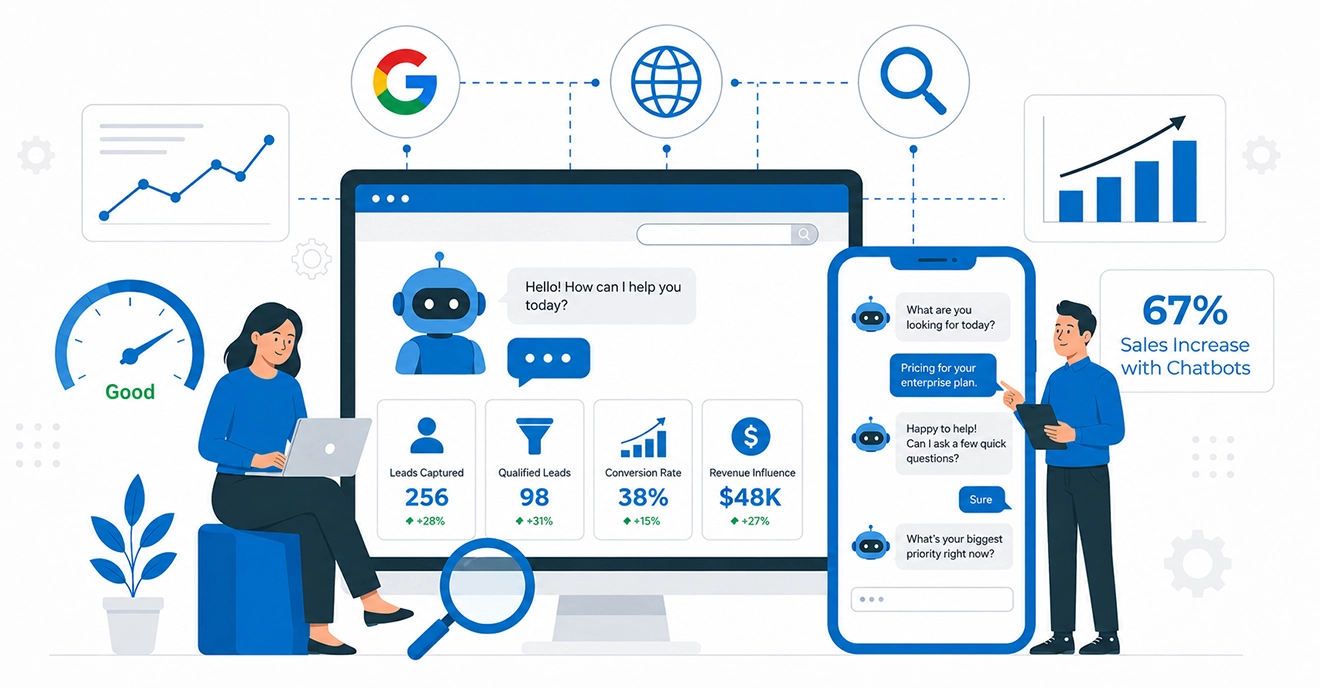
AI chatbots can increase website leads, but the lift is conditional rather than automatic. In Intercom’s Chatbot Trends Report, business leaders reported an average 67% increase in sales after adopting chatbots, and 26% of all sales started in a chatbot conversation (Source: Intercom, 20191). Tidio’s research adds that 55% of companies using chatbots for marketing see a rise in high-quality leads (Source: Tidio2).
Treat those numbers with care. They come from surveys of businesses that adopted chatbots and kept them, which skews the sample towards success stories. Companies that installed a bot, watched it irritate visitors and switched it off rarely show up in vendor research.
The economic direction is still clear. According to Gartner, conversational AI will reduce contact centre agent labour costs by US$80 billion in 2026, which is why serious investment keeps flowing into the category (Source: Gartner, 20223). The honest summary: chatbots lift leads for businesses that treat them as a conversion tool, and fail for businesses that treat them as decoration.
Where AI chatbots genuinely lift leads
The clearest gains appear in situations where speed decides the outcome. A visitor is closest to converting at the exact moment a question forms, and a chatbot is the only channel that answers within seconds at 2 am.
Do chatbots increase conversions in practice? They do when they:
- Capture after-hours enquiries. Visitors browsing at night or from another time zone get answered and logged instead of lost.
- Cut speed to first response. An instant reply keeps a buyer on your site while a competitor’s contact form promises a reply “within 48 hours”.
- Qualify before sales gets involved. Three or four questions about need, budget and timeline filter browsers from buyers.
- Replace long forms. A short conversation feels lighter than a nine-field form, especially on mobile.
Consumer behaviour backs this up. Tidio found that 82% of people would rather talk to a chatbot than wait for a human response (Source: Tidio²). Across HMMBiz client projects the pattern is consistent: bots that answer real pre-sales questions on high-intent pages perform, while bots that greet every homepage visitor get ignored.
Where chatbots annoy visitors and lose leads
A badly configured chatbot can cost you enquiries you would otherwise have received. The same research cycle that recorded the 67% sales lift also found that 87% of consumers still prefer a human for quick interactions (Source: Forbes, 20194). That preference hardens quickly when a bot behaves badly.
The failure patterns repeat across industries:
- Instant pop-ups. A widget that opens within two seconds interrupts reading and covers content on mobile.
- Dead-end answers. Bots that loop through “I didn’t quite get that” burn trust in a single exchange.
- Gated help. Demanding an email address before answering anything reverses the value exchange.
- No human escape hatch. Visitors who cannot reach a person abandon both the chat and the site.
- One script everywhere. The same greeting on a blog post and a pricing page tells visitors nobody thought about them.
In regulated sectors the stakes rise further. One wrong or evasive answer about healthcare or financial matters can undermine confidence in the whole brand, so answer accuracy matters more than answer coverage.
What separates high-converting chatbots from ignored ones
Four variables decide the outcome: placement, response quality, qualification flow and human handoff. Get all four right and the bot earns its keep; miss one and the numbers sag.
Placement and timing
Put the bot on pricing, service and product pages, where unanswered questions block purchases. Trigger it after 20 to 30 seconds or on exit intent, and keep it collapsed by default on mobile.
Response quality
Train the bot on the questions your sales team actually hears: pricing logic, delivery times, integrations, compliance. If it can handle the ten most common pre-sales questions accurately, it earns the right to ask for contact details.
Qualification flow
Keep it to three or four questions: what the visitor needs, rough scale or budget, timeline, then contact details last. Asking for an email first is the fastest way to end a chat.
Human handoff
Every flow needs a visible route to a person, whether that is live chat in business hours or a guaranteed callback. Handoff is where chatbot leads become sales conversations, so it deserves as much design attention as the bot itself.
HMMBiz applied these rules when building Chato, its AI website chatbot: page-aware answers, short qualification flows and a human handoff by default. Whichever tool you choose, hold it to that standard before you pay for it.
How HMMBiz Unified Patient Engagement for a UK HealthTech Platform
HMMBiz worked with a leading UK health technology company to solve fragmented patient engagement across its care platform. We built a scalable digital healthcare platform with automated engagement workflows and intelligent system integration. The outcome: improved operational efficiency and a platform that supports next-generation care delivery.
Read the Full Case Study: Leading UK HealthTech Company
Getting traffic but not enquiries?
HMMBiz designs websites and conversion journeys that turn visitors into qualified leads, chatbot or no chatbot.
How to measure website chatbot ROI
Website chatbot ROI is measured in qualified leads, not conversations. A bot that handles 500 chats a month and produces four enquiries is underperforming a decent contact form, whatever its engagement dashboard claims.
Measure it in five steps:
- Baseline first. Record form fills, calls and email enquiries for the month before launch.
- Tag bot leads at source. Push every chatbot enquiry into your CRM with its own source label.
- Track qualification rate. Work out what percentage of bot leads become genuine sales conversations.
- Compare cost per qualified lead. Divide tool, setup and upkeep costs by qualified leads, then compare against your other channels.
- Review at 60 and 90 days. Keep, fix or remove the bot based on that comparison alone.
Give the trial a fair window. Most flows need two or three rounds of tuning before the numbers settle, and chat transcripts will show you exactly where visitors drop out.
Should you add a chatbot to your website? A decision guide
Add a chatbot if you already have steady traffic and enquiries but lose them to slow responses; fix your traffic first if you do not. A bot multiplies an existing flow of visitors, and no widget can create demand from nothing.
A chatbot is a strong bet when:
- You receive enquiries outside business hours or from other time zones
- Your average first response takes longer than an hour
- Your team answers the same pre-sales questions week after week
- Your contact form converts poorly, especially on mobile
Hold off when traffic is thin, your answers are undocumented, or nobody owns the follow-up. In those cases the budget works harder on a structured digital marketing programme first, because qualification tools need something to qualify.
Weighing up a chatbot for your website? Talk it through before you buy.
HMMBiz helps businesses plan, build and measure lead-generation journeys across web development and digital marketing.
 +1 862-246-6249
FAQs
1. Do AI chatbots actually increase website leads?
Yes, when they are configured to qualify and route enquiries rather than just chat. Surveyed businesses report real gains, including a 55% rise in high-quality leads among companies using chatbots for marketing (Source: Tidio2). Results depend on placement, answer quality and a working human handoff.
2. What is a good conversion rate for a website chatbot?
A useful target is for the chatbot to convert engaged conversations into leads at a higher rate than your contact form. Track the percentage of conversations that end with a captured, qualified enquiry and compare it with your form completion rate. If the bot still underperforms the form after 60 days of tuning, change the flow or remove it.
3. How is an AI chatbot different from live chat?
Live chat connects visitors to a human agent, while an AI chatbot answers automatically using trained content and scripted flows. Chatbots respond instantly at any hour but need a handoff path for complex questions. Most high-performing setups combine both: AI for first response and qualification, humans for sales conversations.
4. How much does an AI website chatbot cost?
Entry-level AI chatbot tools typically start between £20 and £100 per month, while trained, CRM-integrated lead-generation setups cost more once design and integration are included. The larger investment is usually setup: writing accurate answers, building qualification flows and connecting your CRM. HMMBiz scopes chatbot and conversion projects individually so pricing reflects your traffic volume and sales process.
5. Where should a chatbot appear on a website?
High-intent pages first: pricing, services, product and contact pages. Delay the prompt until a visitor has spent 20 to 30 seconds on the page or shows exit intent, and keep the widget minimised on mobile. Sitewide instant pop-ups are the fastest way to get the chat window closed for good.
6. Do chatbots work for B2B lead generation?
Yes, particularly for B2B businesses with longer sales cycles, because the bot can qualify budget, timeline and fit before a salesperson gets involved. Speed matters most here: an instant first response keeps buyers engaged while competitors take hours to reply. HMMBiz typically pairs chatbot qualification with CRM routing so sales teams only see genuine prospects.
REFERENCES
1. Intercom – “Intercom Chatbot Trends Report” (2019)
2. Tidio – “Chatbot Statistics” (accessed July 2026)
3. Gartner – “Gartner Predicts Conversational AI Will Reduce Contact Center Agent Labor Costs by $80 Billion in 2026” (2022)
4. Forbes – “AI Stats News: Chatbots Increase Sales By 67% But 87% Of Consumers Prefer Humans” (2019)
 Table of Contents